
How leaders shape our response to stress: Appraisals, resources, and calibration

Stress can be a burden, but it can also be fuel.
This sentiment captures the divergent and polarizing views we sometimes hold about stress in modern society. Is it the devil, or the path to promise? Does it giveth, or does it taketh away?
On one hand we might regard stress as a malign force, the barbarians approaching the city gates, armed with pitchforks and torches, that must be kept at bay. If let inside, into our lives, we fear it could cause illness or disease. So we strive to insulate ourselves from it in the practices we adopt (meditation, exercise, distraction etc). This perspective suggests we should avoid stress at all costs.
And yet stress has another face, it is also the fuel that animates growth and accomplishment. Stress can energize and inspire us. It can propel us to work harder than we otherwise might. And it can accelerate learning and growth. (Most clients I’ve worked with, if asked, will admit that the moments in their careers in which they learned the most, also happened to be the most stressful.) This perspective suggests we should approach stress, that despite the discomfort it induces, it’s the price of growth.
These two opposing perspectives suggest stress can spark more than one motivational trajectory in us: it can crush us into debilitation, or focus and energize us.
So what determines these two trajectories? In this article, I’d like to suggest that effective leadership is one of the forces that shapes our interpretation of and response to stress, and ultimately how motivated we feel because of it. I’ll describe three different ways leaders might influence our ability to process stress. The first involves helping us to alter the meaning of stress, by encouraging us to perceive it as a challenge, and not a hindrance or threat. The second is by providing important resources – support, information, clarity, feedback, or direct assistance (i.e., removing roadblocks) - that help us offset the demanding and draining elements of stress. The third way leaders shape our reaction to stress is by calibrating demands and objectives to the right level of intensity, abiding by a kind of ‘goldilocks principle,’ so that the degree of challenge is not too much or too little, but just right.
Appraisals: Stress is in the eye of the beholder
Years ago two researchers named Richard Lazarus and Susan Folkman developed an interesting idea about how people respond to stress.
They suggested that when we perceive a stressor, we go through an ‘appraisal’ process to determine what we think and feel about it, and how we will react to it. Are the demands challenging or threatening to me? Will the stress help or hurt me? In simplest terms, is this stress ‘good’ or ‘bad’?
It turns out that when presented with a stressor, we can form one of three different interpretations or appraisals about it: challenge, hindrance, or threat.
Challenge appraisals focus on the potential for mastery, growth, gains, rewards (e.g., recognition and praise), and elicit positive emotions.
Hindrance appraisals involve perceiving that the stressor will obstruct or get in the way of learning, development, and/or goal achievement.
Threat appraisals involve the perception that a stressor can cause direct and significant personal harm or loss.
The type of appraisal is important. There’s now ample evidence to suggest that challenge appraisals lead to better coping, motivational and performance outcomes than hindrance or threat appraisals.
So we can interpret stress in multiple ways, and our ability to ‘appraise’ a stressful situation is malleable.
Let’s connect these ideas back to leadership. One emerging theme in the growing research on appraisals is that effective leaders use this ‘malleable’ quality to shape in us more adaptive interpretations of stress. In particular, they guide us towards interpreting stress as a challenge, not as a hindrance or threat.
For example, one study of US Marines found that soldiers working under charismatic leaders tended to more often perceive stressors that had a tinge of developmental opportunity to them (confusingly called ‘challenge stressors’), using challenge appraisals. And this challenge appraisal in turn led to higher levels of job performance. So charismatic leaders encouraged challenge appraisals, which contributed to subsequent superior job performance.
Another study found that when leaders exhibited pressure on employees to demonstrate greater creativity, those working under servant leaders tended to interpret that pressure as a challenge, and were more likely to generate creative output as a result of it. Those who worked under supervisors rated low on servant leadership, interpreted the pressure to increase creativity as a hindrance, and their resulting creative output suffered.
Yet another study found that those working with a leader they had a strong relational connection with tended to interpret a competitive work climate (a stressor) as a challenge, and felt more engaged as a result of it. Conversely, employees who lacked a strong relational connection with their leader tended to interpret a competitive work climate as a hindrance, and were more likely to feel burned out as a result of it.
So this way of thinking about stress suggests that it’s a kind of construction that we form in our minds. We infuse neutral stressors with meaning and significance, and that influences how we later respond to them. In addition, effective leaders – using any number of positive styles, as the studies above show – have the ability to forge in our minds a more constructive and adaptive way to interpret stress.
Leadership as a resource
The second way leaders influence our interpretation and response to stress is by offering themselves as a resource to directly assist with addressing the demands of work.
Imagine for a moment that you’re at the office and there’s a table in the hallway in front of you. You can’t walk by it to get to your next meeting. There’s no room, it’s too heavy, you can’t move it. If your leader stopped by and said ‘hey just think about that table as a challenge, not a hindrance!’ – that might not be very helpful. But if the leader rolled up their sleeves, summoned five other strong coworkers, and then helped to coordinate moving the table out of the way so you could carry on with your work, that might do the trick.
This simple example illustrates that effective leadership is practical, useful, and a resource during times of stress. It offers tangible tools – like support, information, feedback, guidance – that we can use to cope with and resolve stressors.
This way of thinking about leadership and stress emerges from another framework called the job demands-resources model, which suggests two categories of factors can influence our experience of stress…. you guessed it, demands and resources.
Job demands require sustained effort and impose physiological and/or psychological costs on us. They might include time and work pressure, work volume, role conflict, or emotionally demanding interactions with customers or clients.
Job resources are aspects of the job that are functional in achieving work goals, reduce job demands, and stimulate personal growth, learning and development. Job resources might include autonomy, skill variety, performance feedback, opportunities for learning, and organizational or supervisor support.
This framework suggests demands and resources can initiate two very different motivational pathways. Demands (or too many of them) shunt us towards a health-impairing pathway characterized by stress, exhaustion and possibly burnout. Resources by contrast propel us towards a more positive and motivational pathway, characterized by enhanced engagement, creativity and performance.
It turns out that effective leadership is a bona fide job resource that provides helpful support, information, feedback, and instrumental assistance (e.g., removing roadblocks, or shielding the team from outside pressures) that gives us the concrete and tangible resources to do hard things.
 Tim Jackson
This article provides more details the kinds of behaviours Instrumental Leadership involves.
One final point is that effective leadership is a valuable resource because it helps us practically solve the problems presented by stress, but it also helps us ‘appraise’ difficult demands as surmountable. If your boss asks you to chase a difficult goal, but agrees to give you a huge number of resources to accomplish it, you’ll feel the goal is more achievable. Hence the maxim I sometimes use with my clients: “lots of resources make hard goals seem easier; fewer resources make easy goals seem harder.”
So this perspective suggests that stress is a set of practical problems, that effective leadership directly and pragmatically helps us address; in addition, great leadership indirectly helps us to see hard situations as easier to resolve and manage.
Leadership as a calibrator: All things in moderation
A third way leaders can shape our experience of stress is by influencing the intensity of the demands we work under.
In the early 1900s, two psychologists by the name of Robert Yerkes and John Dodson completed experiments on the speed of learning in mice and found the animals learned best when induced with mild and not extreme electrical shocks. This principle later developed into a widely cited ‘law’ describing the influence of arousal on human performance. The Yerkes-Dodson law states that more arousal facilitates performance up to a point, and beyond that threshold erodes it. Furthermore you can depict this with a bell-shaped, or inverted-U shaped curve. (If you’ve ever played youth sports, you may have heard a coach describe the importance of getting excited but not too excited for the game – same idea.)
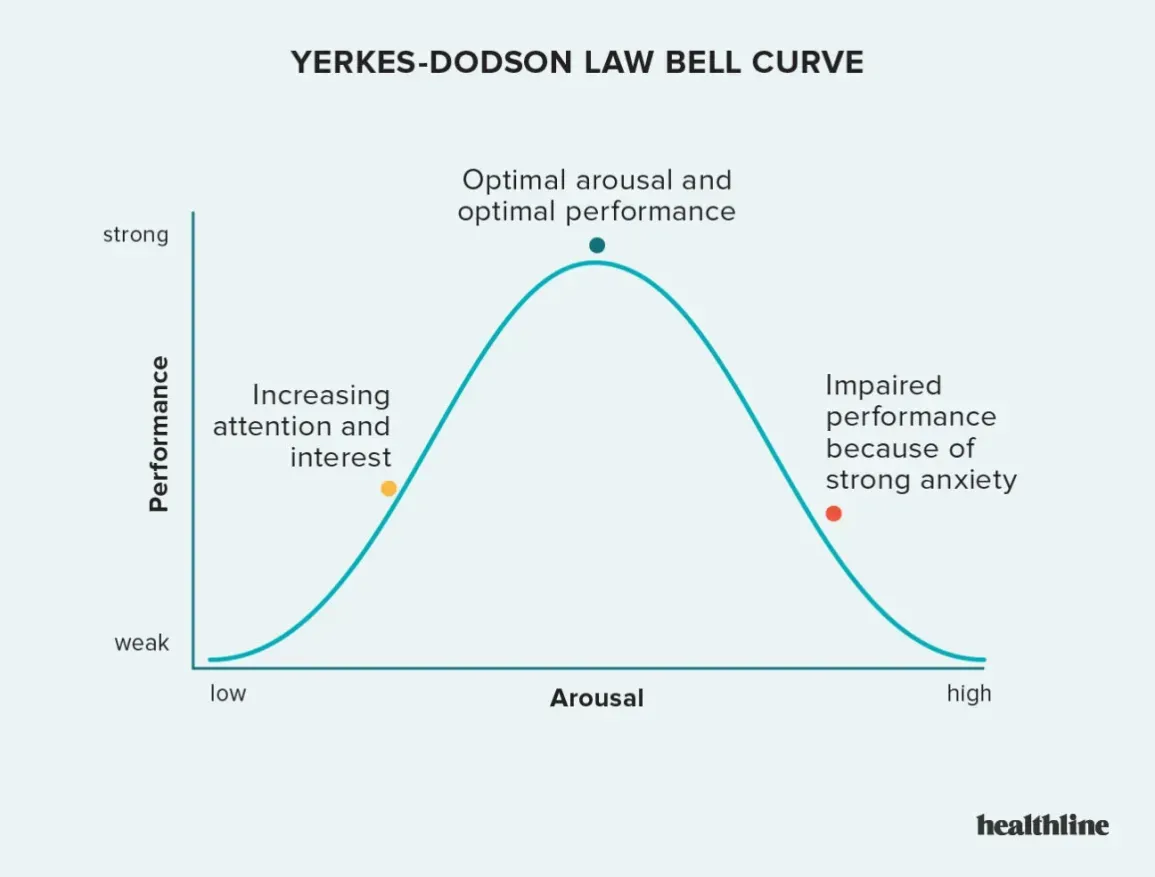
How does this relate to leaders shaping our experience of stress? Leaders often calibrate the level of challenge or difficulty they infuse into the goals they assign their teams. In other words, they have some say about how much ‘goal stress’ their team will feel. Just like the Yerkes-Dodson curve implies, if leaders don’t challenge enough, then team members likely won’t perform to their potential; but if they challenge too much, team members may become exhausted and burnout. In this way, leaders play a major role in influencing team members’ experience of stress.
Research evidence backs up this inverted U-shaped, bell-shaped, or ‘goldilocks’ effect of stress, where moderate amounts seem best. One study found that if leaders imposed moderate creativity expectations on others, this reduced emotional exhaustion and increased subsequent employee creativity.
Other studies found that moderate amounts of time pressure led to the highest supervisor-rated innovative behaviour.
A growing array of findings also suggests that while challenging goals motivate high performance, those that are too difficult or viewed as impossible lead to lower performance and in many cases unethical behaviour.
So this perspective on stress suggests that 'the dose' is important - too little stress tempts underperformance, while too much invites burnout. Leaders play an important role in setting the right dose, since they are the gatekeepers who calibrate the level of challenge, difficulty, or intensity that’s embedded within the goals teams pursue.
 Tim Jackson
See this article for more on the promise and perils of stretch goals.
 Tim Jackson
The idea of moderation in leadership has emerged as an important concept. I discuss it in more detail in this article.
Practical applications
So far I’ve described three ways to think about how leaders influence our interpretation of and response to stress. How can you put these principles into practice?
- Help your team appraise stress as a challenge: Remember that the way your team thinks about stress is malleable. They can perceive it as a challenge, hindrance or threat. And you want them firmly on ‘Team Challenge Appraisal.’ Help your team see through the fog of their assumptions and preconceived notions to notice the benefits related to the stress. Highlight the learning, development, or career advancement opportunities. Help them to see what’s fun or exciting about the stress. Maybe this is a goal that no one has ever accomplished. Maybe we can be the first to do it. Maybe we’ll spend the rest of our lives feeling proud about what we did here. Like a blacksmith, get out your tools, and do what you can to forge a more positive interpretation of the stress.
- Provide as much direct assistance, support and resources as possible: Stressors motivate, and demands demotivate. If you’re demanding a great deal from your team, like asking them to pursue a difficult goal, provide as much direct support and assistance as possible to buffer against the stress. You, as leader, are a major resource to them, and they need your investment to overcome the demands. Also, your direct contribution of resources will not just help them succeed, in a practical way, it will also help them appraise the stress as a challenge. What kinds of resources should you provide as the leader?
- Social and interpersonal support, in the form of mentorship, guidance, encouragement, and a strong relationship.
- Performance feedback.
- Autonomy.
- Role clarity, including clarifying priorities.
- Participation in decision making.
- Learning opportunities.
- Career opportunities.
- Instrumental support, by removing obstacles, providing useful tools, sharing information, securing financial resources, boosting headcount, helping to shift priorities, and filtering pressures or distractions initiated by other teams.
 Tim Jackson
In this article I discuss how important it is for leaders to share information, using a concept called 'signaling.'
- Use moderation when setting goals: If you have control over goal setting for your team (and I understand this may not always be the case), find ways to moderate your objectives. Challenging goals are great and even necessary; impossible goals are a death sentence (i.e., people will give up, cheat, or leave). Calibrate the difficulty of goals so that people feel some stress, but not so much that it contributes to chaotic and disordered thinking, or worse, withdrawal and burnout.
- Keep tending the garden: Understand that the interpretation and response to stress is dynamic, changes over time, and needs to be tended to like a garden. Team members’ interpretations of stress may fluctuate day to day, or week to week. You will need to negotiate and renegotiate the meaning of the stress or the meaning of the challenging goal you’re asking followers to pursue. At some stage in the project, team members may fall off the ‘challenge appraisal’ wagon and start thinking differently about the goal. That’s when you need to re-engage with them to invest new resources, and to remind them of why the stress is worthy of enduring.
Music
Further reading
Tim Jackson, Ph.D. helps executives develop the leadership skills needed to do great things. He is President of Jackson Leadership Inc., a consulting firm located in Toronto. His services include interview-based 360 assessment and development planning, executive advisory, comprehensive leadership development, evidence-based workshops, and leadership and culture audits.
Throughout his 20-year career, Tim has worked with CEOs, executives, and managers across Canada, the US, Europe, and China, spanning 11 industry sectors and every major functional area. Some of his past clients include BASF, Maple Leaf Foods, Canada Packers, Equinix, Husky Injection Molding, Spin Master, Greater Toronto Airport Authority, Algonquin Power and Utilities, Onex, AstraZeneca, Harlequin, SunOpta, Creation Technologies, Gatestone, Leadiant Biosciences, and Protein Industries Canada.
Tim has published his ideas about leadership in The Globe and Mail, Forbes.com, HR Executive, SmartBrief, peer-reviewed journals, several HR trade magazines, and his newsletter at www.timjacksonphd.com.
Tim has a Ph.D. in Industrial/Organizational Psychology from Western University, where he conducted and published research on how inspirational leadership fosters employee commitment.
Please reach out with feedback about this article, or any questions you might have about leadership development.
Email: tjackson@jacksonleadership.com
Phone: 647-969-8907
Website: www.jacksonleadership.com
Newsletter: www.timjacksonphd.com

Member discussion