
Do leader high performance expectations inspire?

A client recently asked me to create a 1 hour seminar on how leaders can become more inspirational.
The gist of the session is that I would define what inspiration means in a leadership context, according to three independent research programs that studied it. I’d look for the overlap between the three programs, and isolate what ‘inspirational’ behaviours they all had in common.
With this distillation complete I would then say ‘ta da!... this is what it means to lead in an inspiring way, and therefore what you should do when managing your teams.’
What are the common factors that represent the core of inspirational leadership, which executives should try to express in their roles?
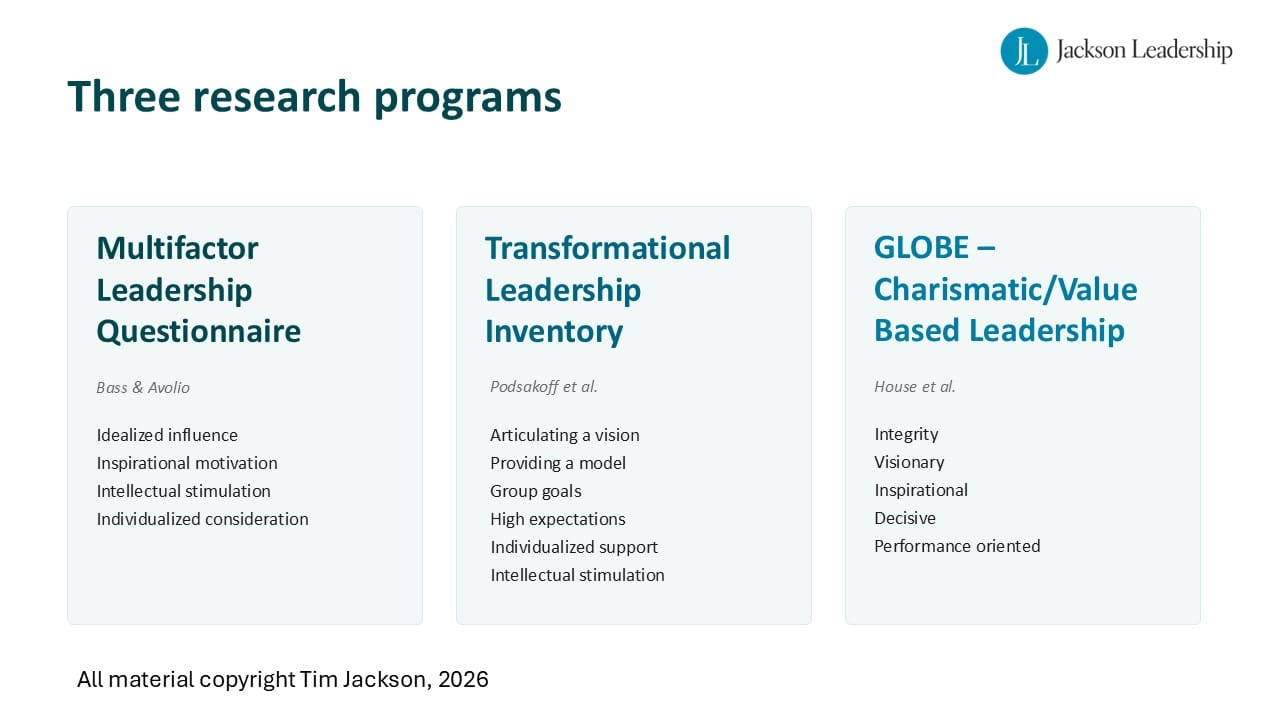
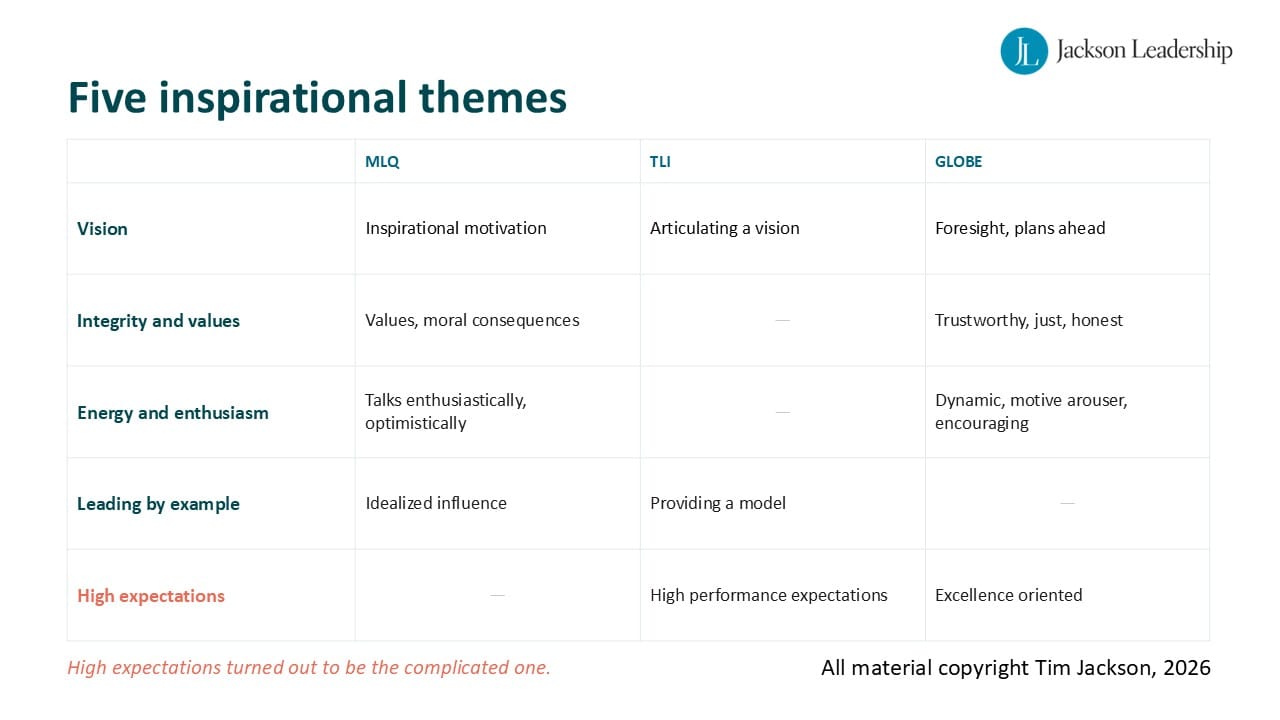
The first factor, mentioned by all three research programs, is ‘Vision.’ It involves creating and articulating a future-oriented plan, goal, or idea of what you want to accomplish.
The second factor, mentioned by two of the three programs, is ‘Integrity and Values.’ This involves leaders talking about their values and beliefs, considering the moral consequences of decisions, and emulating personal attributes like ‘trustworthy,’ ‘just,’ and ‘honest.’
The third factor, also mentioned by two of the three programs, was ‘Energy and Enthusiasm.’ This involves leaders talking enthusiastically about what needs to be done, talking optimistically about the future, and embodying the descriptors ‘dynamic,’ ‘motive arouser,’ and ‘encouraging.’
The fourth factor, yet again mentioned by two of three programs, was ‘Leading by Example.’ This involves acting as an admirable role model by doing things like instilling pride in others for being associated with you, and engendering a sense of respect from followers. It could also involve leaders lending a hand to directly perform or accomplish work, and not simply telling others what to do.
Ok so those are the first four factors that constitute inspirational leadership. But there is one more, and .... it's complicated.
The fifth potential pillar of inspiration was ‘High Performance Expectations’ (HPEs). The following are some behaviours that might fall into this category:
1. Showing others that you expect a lot from them.
2. Insisting on only the best performance.
3. Not settling for second best.
So when I first read this list of behaviours - and I recognize this may be antithetical to how some corporate leaders are wired - I didn’t think they were very inspirational. On their own, ‘naked’ and unpaired with any other qualities, they felt like pure demand and stress, falling far short of any threshold at which they could inspire.
Despite this, one of the research programs I examined categorized HPEs as part of the family of inspirational leadership behaviours. This program is the GLOBE research project (the acronym stands for the Global Leadership and Organizational Behavior Effectiveness project). In its first phase, it sampled about 17,000 managers, across almost 1000 organizations, in 62 societies around the world. It found that two leader styles were universally endorsed as effective in the vast majority of the 62 societies studies: ‘Charismatic/Value Based,’ and ‘Team Integrator/Facilitator.’
 Tim Jackson
If you want to know more about GLOBE, check out this long-winded article.
The first of these, Charismatic/Value Based leadership, was where all the inspirational and visionary 'stuff' ended up based on their statistical analysis. But notably, it included the leader attribute ‘excellence oriented.' In short, GLOBE's results suggest HPEs are highly similar to, and cluster together with, other inspirational leader behaviours.
 Tim Jackson
If you're interested to learn more about inspirational leadership, check out this article.
 Tim Jackson
I've also written about inspirational leadership here.
 Tim Jackson
More details on charismatic and inspirational tactics here.
Can high performance expectations fly solo, or do they need a partner?
So which is it? When leaders set big, bold, stretchy, demanding targets, is that inspirational? Or is it deflating and demotivational?
As I built out my presentation, I landed on a nuanced answer to that question.
It seems like the first four leader behaviours – Vision, Integrity and Values, Energy and Enthusiasm, and Leading by Example – might all have the potential to inspire on their own, independently, regardless of whether they occur alongside other any complementary behaviours. They don't need accompaniment, each can be soloists.
However, when a leader sets HPEs, those demands might only be interpreted as inspirational if paired with other positive leadership behaviours. HPEs might have two faces, motivational or demotivational, and the one that manifests might depend on the other behaviours leaders express alongside the HPE. In short, HPEs need an ensemble, or at least a partner, to sound beautiful (or motivating).
So what complementary behaviours should leaders express in tandem with HPEs, to convert them into inspirational music? In the next section I’ll outline three that could be useful (though I’m sure there are others).
Expressing confidence in followers
One important behaviour leaders may need to express in tandem with HPEs is confidence that the follower can achieve the hard goal.
"There is this hard thing I’d like you to do, and I really believe you can do it.”
Years ago, a famous leadership scholar named Robert House was perhaps the first academic to write about HPEs. In the 1970s he developed a theory in which he asserted that effective charismatic leaders needed to be ‘achievement oriented’ (an idea similar to HPEs). For example he said they should encourage performance excellence, set challenging goals, and seek improvement.
In that theory however, he also asserted an important caveat: that setting HPEs would only be motivating for followers if the leader paired them with a statement that they believed the follower could achieve the objective. The rationale was that followers need a self confidence boost to encourage and energize them to strive towards difficult goals.
Years later, another researcher named Albert Bandura developed and validated the notion of ‘self-efficacy’ (essentially a synonym for self-confidence) and showed that it was a critical ingredient for persisting in the face of difficulties.
Goal setting researchers also converged with this idea and found that people tend persist longer in pursuit of a goal, and are more likely to achieve their goals, when they also possess high self-efficacy.
So Robert House was ahead of his time, and right all along. If leaders are going to challenge their teams to the limit, they also need to stoke the confidence of followers to achieve the hard goal. If you're going to try to do something hard, it's important to believe -firmly - that you can do it.
Giving support – relational and instrumental
Another quality leaders may need to express alongside HPEs in order to render them motivational, is support.
I divide support into two categories: relational and instrumental.
Relational support represents socio-emotional care and consideration. It might involve sympathy, empathy, encouragement, listening, and showing concern for others’ feelings and needs.
Instrumental support, by contrast, involves leaders directly facilitating the accomplishment of work. This could involve shielding the team from other disruptive stakeholders, aligning stakeholders to support the work the team is doing, and removing roadblocks to performing work. (These types of actions are often referred to in corporate lingo as ‘giving air cover.') Other forms of instrumental leadership might involve sharing critical information with the team, helping the team to set priorities, and providing direct instruction/coaching/guidance to resolve issues.
Creating meaning
A final leader behaviour that could help followers experience HPEs as motivational, is creating meaning.
Leaders shouldn’t delude themselves into thinking that simply declaring a demanding goal will generate instant excitement about it. They need to take followers by the hand, and guide them in interpreting that HPE as meaningful. This could involve helping followers perceive the tough goal as beneficial, important, desirable, realistic, exciting, unique, or in some way leading to positive future states. Linking the HPE to values that the team endorses should help – if a goal connects to deeper values, people will perceive it as more worthwhile and important.
 Tim Jackson
Last month I wrote about how effective leaders help followers perceive stress as a challenge, and less a hindrance or threat - a concept similar to creating meaning.
One last thought
It strikes me that the term ‘high performance expectations’ may be the wrong one to use when thinking about how to inspire as a leader.
An ‘expectation’ assumes that the leader is foisting the goal on the follower. They’re saying “hey, I’d like you to do this really hard thing, and it’s not negotiable, and you have no choice.” Not very inspiring. (I understand this is how many goals are set in corporate settings, but please allow me this idealistic rant.)
I wonder if we should expand our thinking about what leader high performance expectations are, or could be. What if as a leader you asked your followers to set their own really difficult, stretch, ‘moonshot’ type goal? Would self-setting hard goals be more motivational?
And what if, as a leader, you told your team that you’d like to set a difficult performance goal, and that you want to co-create, negotiate, and refine it with them?
My point here is that the idea of 'setting expectations' assumes little agency on the part of the follower. When you combine imposing a hard goal upon followers with offering them little control of the situation, no wonder the whole experience is uninspiring.
Perhaps this problem can be addressed by asking followers to self-set their own high performance goals, or by asking to co-create stretch goals with them.
Practical application
When trying to inspire others:
- Articulate a future-oriented vision or goal related to what you want to accomplish.
- Demonstrate your integrity and values by considering moral and ethical dimensions of decisions, and by talking often about what you believe/value.
- Demonstrate energy and enthusiasm by talking optimistically about the future, and what can be accomplished.
- Lead by example, by taking action (not just directing others and leaving them to toil with the work), and acting in ways that generate admiration and respect.
Also, when setting high performance expectations, remember to demonstrate complementary behaviours at the same time, to ensure your followers perceive the challenge as motivating:
1. Express confidence that you think the team can achieve the tough goal you’ve assigned.
2. Provide support two ways – by showing concern, care, respect, and sympathy for the team member; and by directly engaging with the team to facilitate their work (e.g., removing roadblocks, helping to prioritize, sharing information, aligning other stakeholders). Think 'air cover'!
3. Help the team members realize that despite the difficulty of the objective, that pursuing it can be a highly meaningful experience. Fill your vision with significance by describing what’s beneficial, important, desirable, realistic, exciting, unique, or values-related about it.
Music
Tim Jackson Ph.D. is President of Jackson Leadership Inc., a consulting firm located in Toronto. For more on his bio, or services see the links below.
 Tim Jackson
 Tim Jackson





Member discussion